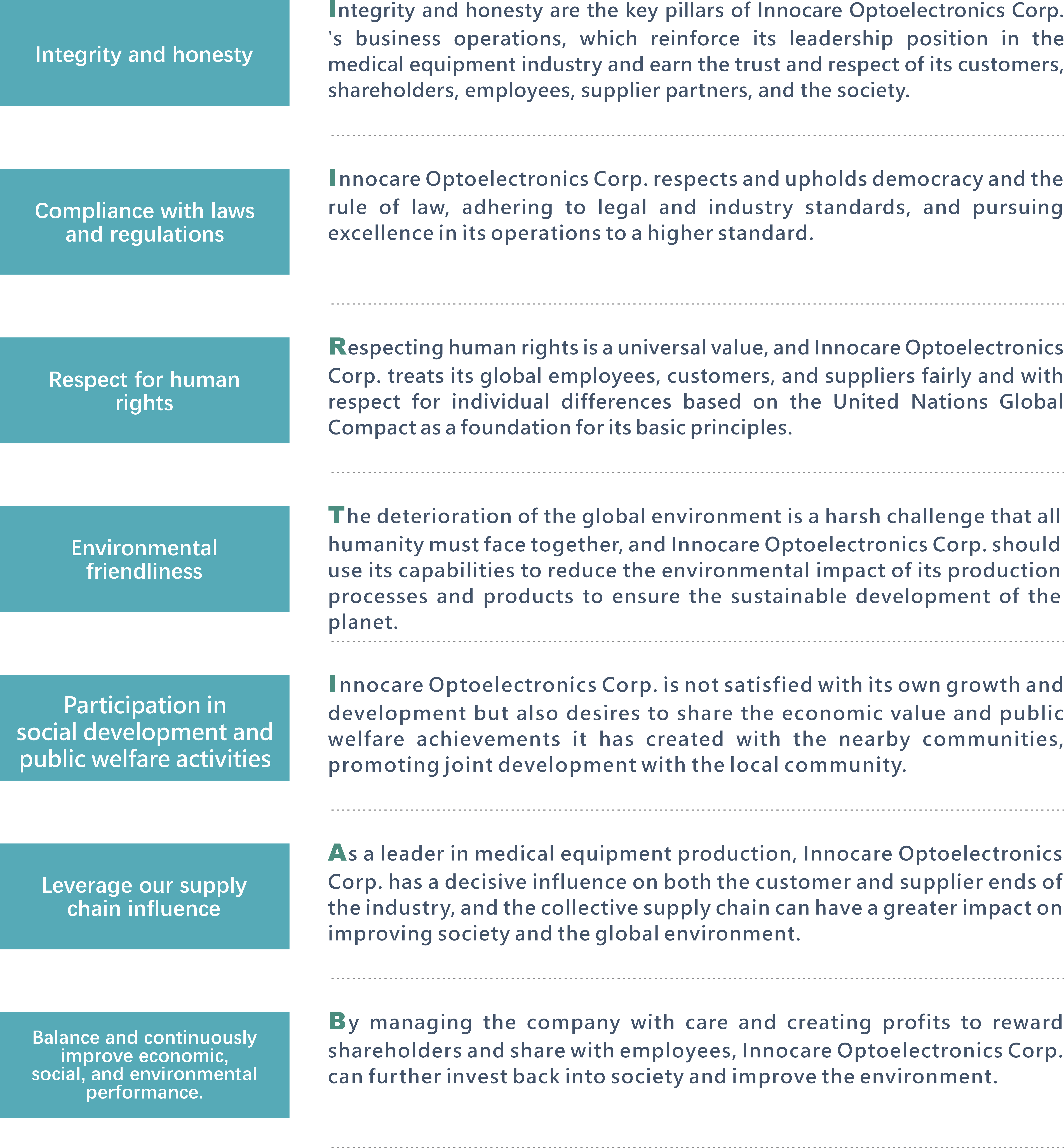
Corporate Social Responsibility Policy
Sustainable Development Policies
InnoCare incorporates environmental, social, and corporate governance (ESG) considerations into its operational strategies to implement sustainable development. We have also followed the Responsible Business Alliance (RBA) Code of Conduct to form the basis of InnoCare. These policies cover five major areas: “corporate governance,” “environmental protection,” “employee care,” “supply chain social and environmental responsibility management,” and “community involvement.” This approach aims to shape the company’s sustainable competitiveness and strengthen communication with stakeholders. By understanding and fully responding to stakeholders’ concerns, these issues serve as an important basis for setting sustainable development goals. Additionally, InnoCare’s “Sustainable Development Practice Guidelines” are based on four main principles: “implementing corporate governance,” “developing a sustainable environment,” “maintaining social welfare,” and “enhancing corporate sustainability information disclosure.” These principles guide InnoCare’s efforts in promoting sustainable development.

Sustainable Development Promotion Organization
The company’s Finance & Accounting & Business Management & HR Division Group serves as the dedicated organization for promoting corporate sustainable development. In 2021, the Board of Directors established the company’s Sustainable Development Practice Guidelines, authorizing the Chairman or a designated person to be responsible for the execution of sustainable development policy systems, related management guidelines, and specific promotion plans. Following the principle of materiality, the company conducts risk assessments of ESG issues related to its operations and sets sustainable development goals to implement corporate sustainable development.
Risk Identification and Management
In response to changes in the global political and economic environment, InnoCare integrates its sustainable business strategy and significant issues, referencing the Global Risk Report published by the World Economic Forum (WEF). The company identifies operational risks, financial risks, geopolitical risks, and key personnel risks pertinent to InnoCare. Relevant departments take early action to address these risks, monitor the associated risks, and propose mitigation measures and response strategies.
| Risk Issue | Potential impact | Overview of coping mechanisms |
| Operational Risks | 1.Risk of Competition and Elimination of Major Products and Technologies: InnoCare holds a customer advantage and technological leadership in the field of X-ray sensors. However, in recent years, with the entry of various manufacturers, market competition has become increasingly fierce. The continuous introduction of new technologies and products and the accelerated transition to mainstream products may impact the sales of the company’s existing products, potentially leading to negative effects on financial operations. 2.Risk of Supply Chain Supply and Concentration of Procurement: The company primarily engages in the design, manufacturing, and sales of X-ray flat panel sensors. During product development and manufacturing processes, maintaining collaborations with suppliers is essential to complete product production through specialized divisions of labor. Since the products are extensively used in the medical diagnostics field, they involve numerous items and have high requirements for technical levels and supply stability. The selection of suppliers requires comprehensive consideration of factors such as process technology, quality yield, production capacity, delivery time, and geopolitical relationships, leading to a concentration of procurement sources for some raw materials. |
1.Facing the Risk of Competition and Elimination of Major Products and Technologies: In addition to continuously investing in the development of new technologies and products in the core sensor product field, the company strengthens its response in various ways. These include “closely communicating with major international customers regarding product and technology directions,” “actively participating in exhibitions and academic seminars,” “regularly monitoring the latest publications in academic journals,” and “diversifying business attempts based on core competencies.” Additionally, the company explores new services and product lines, such as automated industrial inspection equipment, to diversify revenue sources and reduce operational fluctuations. Furthermore, through collaborations and alliances with startups and emerging businesses, the company strategically positions itself in new application areas. 2.Facing the Risk of Supply Chain Supply and Concentration of Procurement: For key components, the company strives to choose more than one supplier whenever possible or mitigates the risk of supply concentration through contracts and establishing safety stocks. |
| Financial Risks | Pandemic and the Russia-Ukraine war have brought global inflation, prompting central banks in major countries to respond with significant interest rate hikes. The differences in interest rates and economic environments across countries affect exchange rates and capital flows. The company has operational bases in the Americas, Europe, and Asia, with customers worldwide. Global operations face the following financial risks: 1.Capital Allocation and Turnover Risk 2.Interest Rate Risk 3.Exchange Rate Fluctuations |
1.The company plans appropriate levels of domestic and foreign currency cash based on operational revenue and expenditure needs. It signs long-term and short-term credit agreements with financial institutions and utilizes borrowing limits according to operational conditions to support cash payments and turnovers. The company maintains sufficient cash levels, thus facing no turnover risks. 2.The company continuously monitors changes in financial market interest rates and their impact on its funds, maintaining good relationships with banks to evaluate the costs of various funding sources. It selects appropriate financing methods to support company growth, and interest rate changes have not significantly affected the company’s profit and loss. 3.Facing Exchange Rate Fluctuations: (1).The finance department evaluates exchange rate fluctuation risks, formulates strategies, and assesses whether to execute hedging transactions. Since the company’s accounts receivable and payable are primarily in foreign currencies, it currently adopts natural hedging, and exchange rate fluctuations have not significantly impacted the company’s profit and loss. (2).The company’s main transaction currencies are the US dollar and the Japanese yen, and it primarily adopts natural hedging methods. Additionally, it evaluates the exchange rate risks arising from major substantial positions to plan hedging transaction strategies, selecting well-established and reputable financial institutions as the main counterparts |
| Geopolitical Factors | 1.The year 2024 is a global election year, with many countries welcoming new leaders and political landscapes. The US-China relationship remains unimproved, the tech war continues, and cross-strait tensions persist. The Russia-Ukraine war and the newly erupted Israeli-Palestinian conflict have intensified geopolitical tensions. These factors profoundly impact the supply chain arrangements across various industries and elevate shipping costs, leading to significant implications. | 1.The company has customers across major global regions, diversifying revenue sources to mitigate the impact of political fluctuations in any single area. The company continuously monitors international developments, maintains friendly and strategic relationships with suppliers and customers, and actively develops new suppliers and customers to reduce related operational risks. |
| key talent | 1.Intense Competition for R&D Talent in Taiwan with Numerous External Incentives. 2.Decreasing Number of Graduates in Taiwan and High-Salary Poaching by Domestic and Foreign Companies. |
1.Global Collaboration with Innolux Group for Recruitment and International Integration: In collaboration with Innolux Group, the company is expanding its global recruitment strategy and aligning with international standards. The recruitment scope has been extended to Southeast Asian countries, offering overseas talents benefits programs and attractive salaries to come to Taiwan, preparing for the organization’s international layout. 2.Strengthening Campus Recruitment Programs in 2024: In 2024, the company will continue to enhance its campus recruitment programs by securing talent before graduation. Through the Campus International Mentorship Program and collaboration with international industry-academia alliances, the company aims to recruit international students from campuses and retain them in Taiwan. |
Task Force on Climate-Related Financial Disclosures (TCFD)
The impact of climate change has led companies to face the challenge of transitioning to net zero. InnoCare responded to the International Sustainability Standards Board (ISSB) by adopting the framework for sustainability information disclosure issued in 2023, focusing primarily on ISSB S2 “Climate-Related Disclosures.” Following the 2017 recommendations by the Task Force on Climate-related Financial Disclosures (TCFD), InnoCare adheres to the four main frameworks of “Governance, Strategy, Risk Management, Metrics and Targets” to help decision-makers and investors effectively focus on relevant issues.
| Governance |
|
| Strategy |
|
| Risk Management |
(2) Periodically convening relevant department heads to jointly review and evaluate significant impacts, quantifying “probability of occurrence” and “impact degree,” and transforming “assets and liabilities” as well as “capital and financing” into eight aspects: revenue, direct costs, indirect costs, capital expenditures, capital acquisition, asset value, premiums, and liabilities, using a two-dimensional matrix to identify significant transition and physical risks and opportunities.
(1) Incorporating climate change into the “Risk Management Policy and Procedures” with the Board of Directors at the highest management level. |
| Metrics and Targets |
Climate Actions: Aligning with the group’s net-zero strategy, aiming for a 25% absolute reduction in greenhouse gas Scope 1+Scope 2 emissions and achieving 20% renewable energy usage (RE20) by 2030.
|
Senior Executive Remuneration and Sustainability-Linked Performance
In accordance with InnoCare’s remuneration policy for board members and senior executives, the Remuneration Committee examines corporate operational performance, individual performance and duties, industry trends, and the standard remuneration for comparable positions in the industry before submitting a proposal for amounts and forms of remuneration for final approval by the Board of Directors.
The senior executives’ performance evaluations encompass both financial and non-financial aspects of their service. The financial aspect of the performance evaluation consists of key indices such as operating revenue and EPS, whereas the non-financial aspect covers environmental, social, and governance (ESG) results with each index and award accounting for 0% to 5% of the final score. Thanks to this comprehensive evaluation system, we are able to formulate a competitive remuneration system that is linked to our operating performance.